
Sylvia Plath’s fig tree meets machine learning—because, why not?
Yet another essay about Sylvia Plath's fig tree but we are involving code

The other day, during one of my usual existential anxiety Substack perusals, my eyes fell upon an essay about Sylvia Plath’s fig tree metaphor. And then another. And another. And another…
I don’t know if it’s my algorithm or the fact that Plath’s metaphor for the paralyzing banquet of choices concerning one’s social identity and self-representation is one of its most poignant literary portrayals. Maybe it is both. As a sucker for Plath’s writing myself, I can only rejoice in seeing her pop up in so many corners of the good Internet, a reminder I should re-read The Bell Jar and shiver in terror.
Plath’s ever-famous, terror-inducing tree metaphor, if you don’t know it, is this:
I saw my life branching out before me like the green fig-tree in the story.
From the tip of every branch, like a fat purple fig, a wonderful future beckoned and winked. One fig was a husband and a happy home and children, and another fig was a famous poet and another fig was a brilliant professor, and another fig was Ee Gee, the amazing editor, and another fig was Europe and Africa and South America, and another fig was Constantin and Socrates and Attila and a pack of other lovers with queer names and off-beat professions, and another fig was an Olympic lady crew champion, and beyond and above these figs were many more figs I couldn't quite make out.
I saw myself sitting in the crotch of this fig-tree, starving to death, just because I couldn't make up my mind which of the figs I would choose. I wanted each and every one of them, but choosing one meant losing all the rest, and, as I sat there, unable to decide, the figs began to wrinkle and go black, and, one by one, they plopped to the ground at my feet.
The popularity of this passage is hardly surprising. Sylvia Plath’s fig tree is an acute representation of being a woman in her twenties, and even when said woman is older, the tree looms, threatening. It might be a representation of being anyone else at any age, but I wouldn’t know, as I was only a woman in my twenties, and, later, a woman in my thirties. I imagine any woman past the blissful ignorance of teenagehood who has read this passage has felt a certain degree of dread. For how often we deeply want multiple lives, multiple choices at once, and how inaccurately we think we can only choose one, a handful at most.
Inaccurately, maybe, is not the right way to put it: what I mean is, no matter what we choose, no matter what fig we pick or not pick, there will always be little mounds of rotten figs on the ground staring back at us, pulling at the sturdy strings of our longing. The only fate worse than that is, of course, remaining sitting in the crotch of this fig-tree, unable to take your pick, as the fruits wither and die. Terrifying. But also, in a way, exhilarating?
And what if we could quantify this particularly Plathian existential dread? In her recent essay, Zoe argues that we are not the figs, but the tree. While my therapist would enthusiastically agree with Zoe, I think Sylvia Plath never meant for us individuals to be the figs either. In my eyes, Esther/Sylvia in the book was stuck looking at her own arborescence from the wrong angle (Ok, this is also what Zoe is saying).
Now, wouldn’t it be wonderful to learn to approach the fig tree in a systematic way that could help us calculate the right answer—the right fig—for ourselves? Say, much like a machine learns to approach unclassified data?
Put simply, machine learning decision trees are at the base of many machine learning algorithms. In them, data is represented as an upside-down tree splitting up into several nodes and branches, where each node stands for a condition, each branch an outcome, and each leaf node (or final decision) a definitive label.
There are several types of decision trees. For this example, we will use a classification tree. Classification trees are designed to classify data into different classes. In Plath’s fig tree, this means choosing a fig corresponding to a class label. Not only: as decision trees recursively partition the data into smaller chunks as they move along the nodes, this should also give the Plathian observer a better grasp on what figs are up for grabs.
Decision trees tend to be trained on known outcomes—for example, if you want to build a tree to help you decide whether you should go see a specific movie or not, you may want to train your tree on past experiences of movies you have seen. In Esther’s case, of course, the taste of each fig is unknown. “One fig was a husband and a happy home and children, and another fig was a famous poet and another fig was a brilliant professor, and another fig was Ee Gee, the amazing editor…”—all figs are possible scenarios that are paralyzing precisely because she doesn’t know what outcome she’d rather have. In this case, then, we need to quantify what we imagine to be Esther’s proclivities, and adjust our defining features accordingly. In other words, we need to translate emotional or symbolic ideas into structured data that a machine learning algorithm can use, treating each fig as a class label.
Our dataset may look something like this:
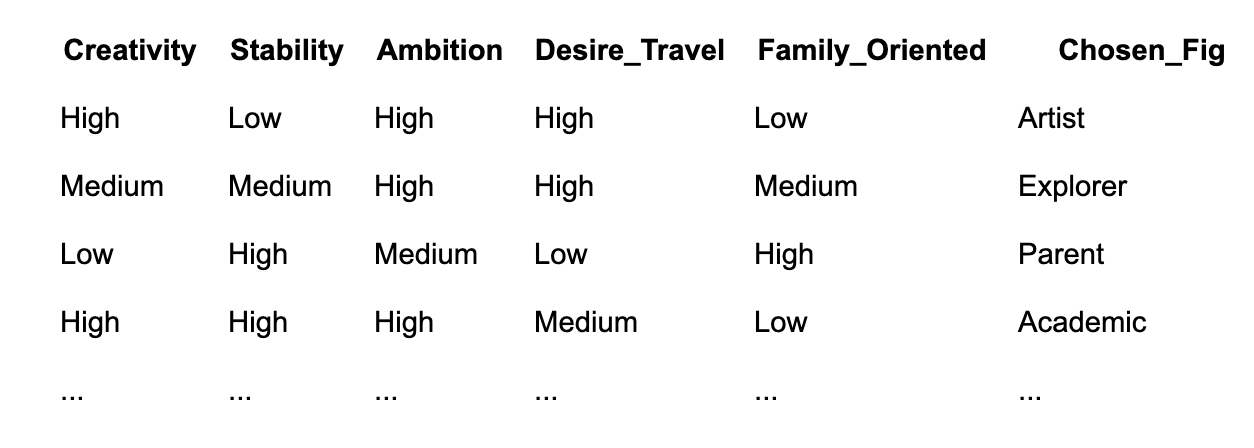
A decision tree works on numerical values, so we need to convert each value into numbers. To make our life simple, let’s say that High is 2, Medium is 1, and Low is 0.
data = {

'Creativity': [2, 1, 0, 2],

'Stability': [0, 1, 2, 2],

'Ambition': [2, 2, 1, 2],

'Desire_Travel': [2, 2, 0, 1],

'Family_Oriented': [0, 1, 2, 0],

'Chosen_Fig': ['Artist', 'Explorer', 'Parent', 'Academic']

}
At this point, we turn our small emotional dataset into a dataframe, define X (features) and y (target) variables, and train our classifier. I’ll spare you the code, but it will look something like this:
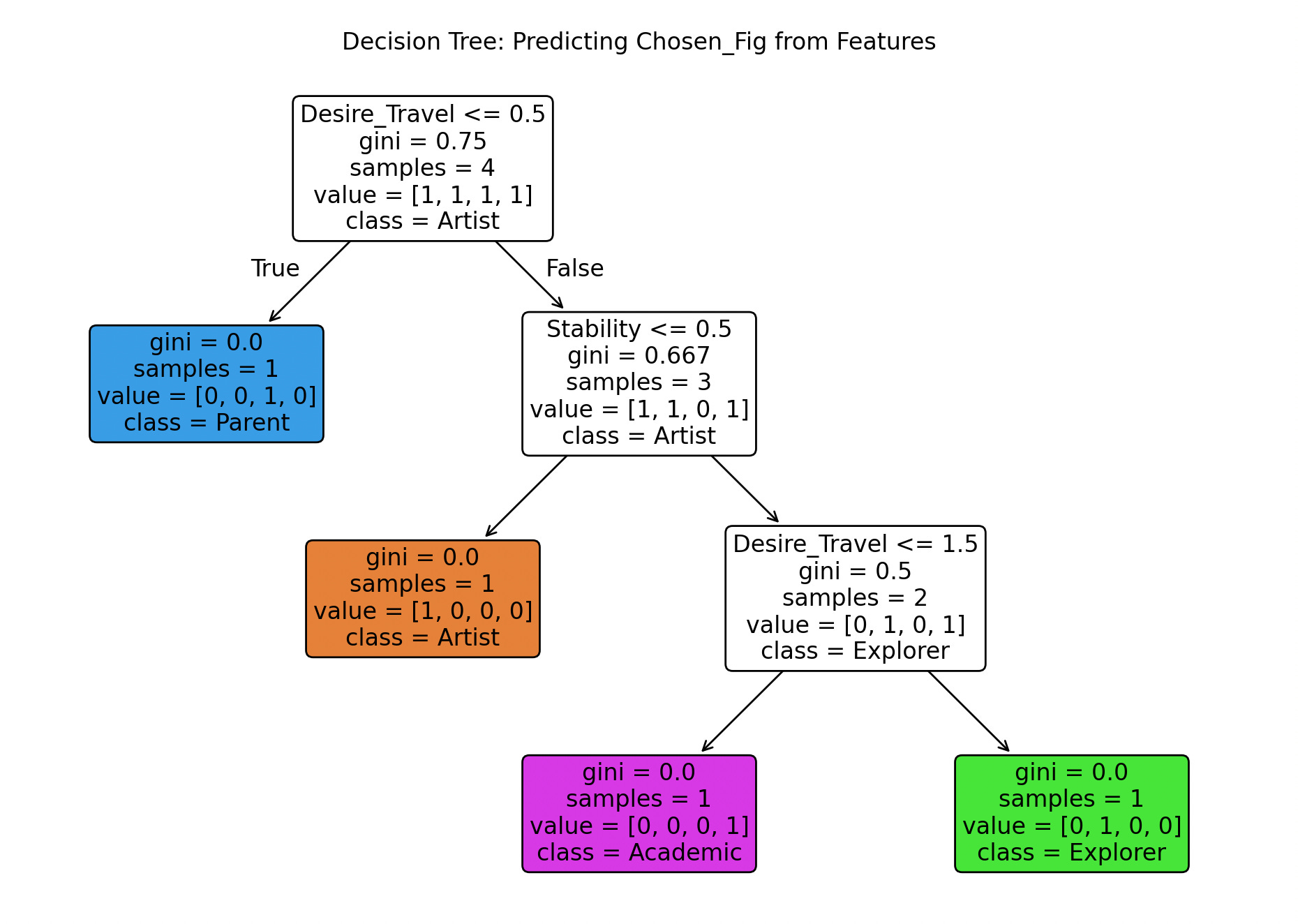
Here, you can see a decision tree trained on the known dataset and prepped to make a decision for us. If we pass it another set of data, such as someone who is high creativity, medium stability, high ambition, wants to travel, not family-oriented:
If we assume that Esther, at the moment she discusses her tree metaphor, is creative, not very stable at all, not very ambitious anymore, with a strong desire to travel and low interest in a family, we’ll have:
Esther = [[2, 0, 1, 2, 0]]Which tells us she should have forgotten every other fig and embrace her creativity:
Predicted fig for Esther: ArtistEven though this is fun, the point is, of course, that we can't quantify any of this.
And even if we could, Esther herself changes throughout her own story, as we all do, and her paralysis is a direct influence on her preferences. She starts off in college as a very talented student, her creativity flaring up, but, during her internship, it seems to mellow out. She starts stable and goal-oriented, only to end up in a hospital. Priorities and preferences shift, and things happen and keep happening.
I could sit down at my laptop and quantify every single shift as Esther matures and changes throughout the story, or apply it to my own shifts and changes. But, of course, the point of shifting and growing in many directions remains that a human is not a fig they get to choose, but the tree. A person is a dynamic, branching identity—a tree of selves.
Sylvia Plath’s fig tree is rooted in indecision and paralysis—the fear of commitment and the FOMO resulting from a chosen path; countless, unchosen little figs falling to the ground. A machine learning model, however, doesn’t overthink it—it goes its merry way, slithering between Yes’s and No’s and categories using only machine logic to get to the juice of its final leaf.
Several times a day, I wish to be like a machine. When I am paralyzed by choices of the smallest size: go out and enjoy the sun, stay in and rest, read a book, watch a movie, work on this project that is due next week or chill the hell out for five minutes. And, yearly, for larger questions: in my thirties, without children, living abroad: How many figs can I still reach out and grab, how many are now on the ground rotting, without me even knowing? Have I chosen right? Have I chosen at all? But the truth is in the roots: a machine doesn’t have any. And sure, it might look as if it had arborescence, but it has none. The results of its growth are already written in the dataset. The reason is simple: as Zoe said, as Esther couldn’t grasp, you are not a separate entity sitting in the crotch of this fig-tree. You are full of ambiguity and gray areas and ideas and contrast and seasons. Basically, you are the tree.
Here is the thing about machine learning decision trees: they are finite. They serve a purpose—to reach the final leaf, to gain classification. And how we yearn to see our decision the same way: to have a finite answer, the best possible answer for us, the right one.
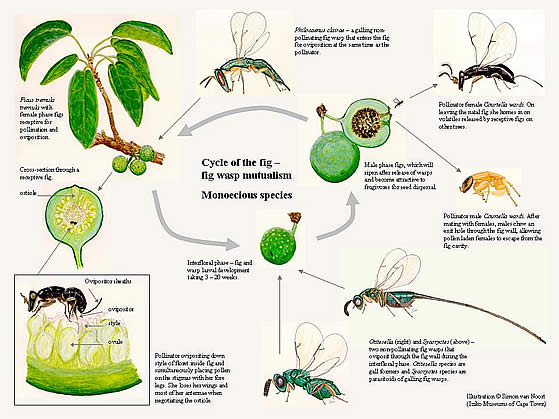
Here is another interesting thing about fig trees that I gleaned from this other essay by The Jane Institute and the neat graph she published: at least when it comes to many species of wild figs, they survive on fig-wasp mutualism. Which means that a fig tree, like all trees, doesn’t do its thing of growing and spouting juicy gems of fruit independently. But, more blatantly than other trees, it relies on wasps pollinating its fruits. We owe figs to wasps: they hatch their eggs inside of them, pollinating them. The female wasps born inside the fig mate there. Outside influence is of the utmost importance—a buzzing, teeming-with-life external entity, which triggers a never-ending cycle that keeps the tree renewing its figs.
If we had to put this into a neat graph of steps and outcomes, as we did with Esther’s decisional process, just to be a little meta, we could do something like:
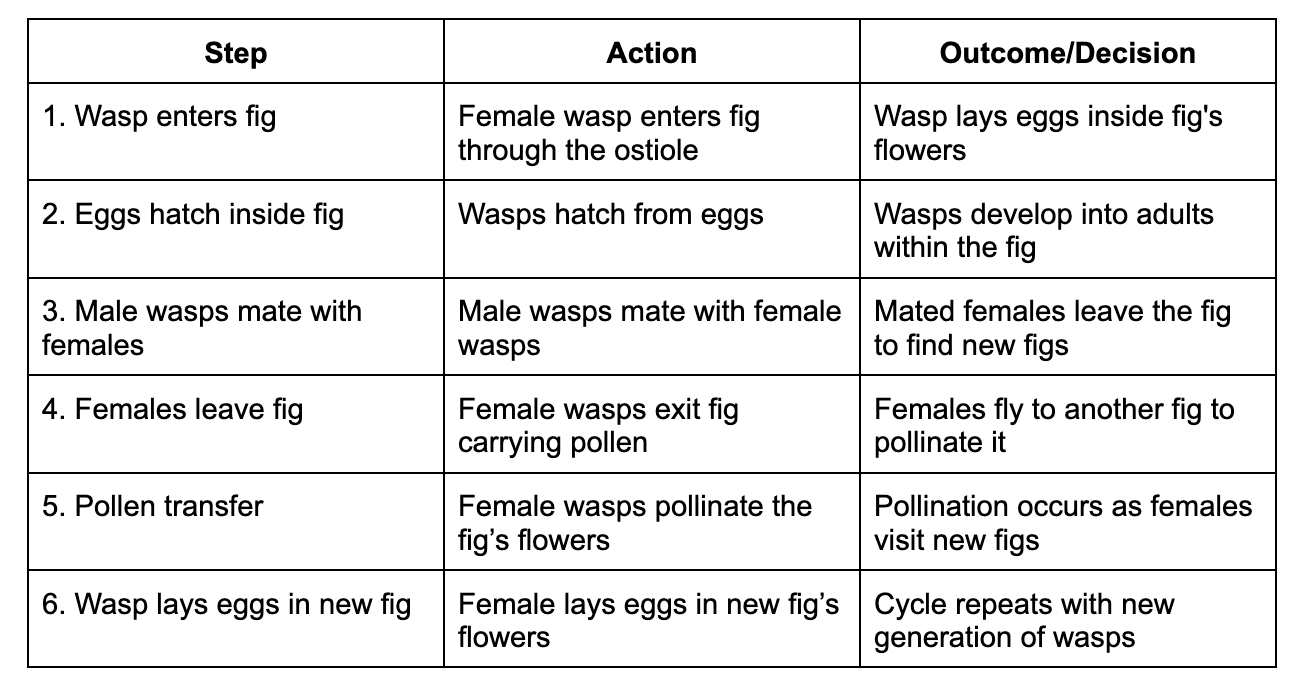
Or:
Fig-Wasp Mutualism (Endless Cycle)
|
├── Female wasp searches for a fig
│
├── Does she find the correct fig species?
│   ├── Yes
│   │   ├── Enters fig and pollinates
│   │   ├── Lays eggs in some ovules
│   │   ├── Larvae develop as fig matures
│   │   ├── New wasps emerge and mate
│   │   ├── Females collect pollen
│   │   └── → Return to: Female wasp searches for a fig
│   │
│   └── No
│   	├── Wasp fails to reproduce
│   	└── → Return to: Female wasp searches for a fig (another wasp tries)
I don’t know why, but this little nugget of information does it for me. It might be my obsession with cyclicality in storytelling, or the fact that I like a reminder that machines cannot solve our emotional problems. In spite of her mental-health-related hardships, and in spite of expectations that she originally set for herself, Esther does give up the pre-set figs to embrace, however tentatively, her own arborescence.
It is through misery and mystery that she creates her own figs and moves past the crotch of this fig-tree. Which isn’t to mean that arborescence is acquired through bad things happening. I think the point is that she lets the wasps swarm in, and from them things are born, and continue to be born, regardless of fear and previous beliefs. No fat purple figs, imagined wonderful futures beckoning and winking, but a cycle of continuation, fed by its own existence, by experience and life, with wasps mating away in and out.
Loved this piece ! Thank you Marta for sharing your thoughts!
I think this view of figs is indeed rather simplistic and as you so wisely say, we "are full of ambiguity and gray areas and ideas and contrast and seasons."